Guides and ResultsEton College
The Definitive Parent's Guide to Eton College Admissions
By Pennyfeather Education 22 July 2026

In short: Entry to Eton College for 13+ (Year 9) begins with registration before the end of Year 5 and unfolds over two assessment stages in Year 6 — Stage 1 (the ISEB Common Pre-Test plus a Head Teacher’s report) and Stage 2 (an interview and an online reasoning test at Eton). Successful boys receive a Conditional Place, later confirmed at 13+ through Common Entrance or the King’s Scholarship. Planning realistically starts several years in advance, not months.
Few schools attract as much attention — or as much anxiety — as Eton College. It is a boarding school for boys aged 13 to 18, with 25 boarding houses and around 1,350 total pupils. These are split into five year groups (‘blocks’) with around 270 boys in each year. It is thought that Eton draws its applicants from over 100 state and independent schools. Competition is intense, the process is long and much of it is poorly understood from the outside. This guide sets out the entire chessboard: the timeline, the assessments, the difference between Oppidans and King’s Scholars and what actually matters at each stage. Individual questions — the Eton Test, the interview, the King’s Scholarship — are explored in dedicated companion articles, each linked below.
When does the Eton admissions process begin?
Earlier than most parents expect. Although the first formal assessment happens in the autumn of Year 6, the decisive first step is registration, and that must be completed well before then.
A boy can be registered at any time up to the end of UK School Year 5 — the academic year in which he turns 10. Eton’s registration deadline is now 31 August (raised from the previous 30 June cut-off). To make this concrete: a boy seeking 2029 entry must be registered by 31 August 2026. These are strict deadlines. Miss them, and the only remaining routes are a scholarship or Sixth Form (16+) entry.
Registration itself is straightforward but non-negotiable in its requirements. Parents complete Eton’s online registration form, upload an unabridged copy of the boy’s birth certificate showing parental details (titled “Certified Copy of an Entry” on a UK certificate) and pay a non-refundable registration fee, which is presently £480 including VAT. Incomplete applications are not processed and may be discarded after a month, so accuracy and timeliness matter.
There is one qualified exception to the Year 5 rule. Boys applying specifically for the King’s Scholarship or a Music Award can enter that process later, in UK School Year 8, up to the age of 13. This is not an open door, however. Candidates from UK schools must still have taken the Eton List Test (or UKiset, for overseas candidates) and achieved a satisfactory score, and only those who perform well enough are then entered for the King’s Scholarship examination itself. More on that route below.
The three-stage journey at a glance
For the standard 13+ applicant, entry to Eton is best understood as three connected phases:
- First, assessment for a Conditional Place across Year 6, made up of Stage 1 (the ISEB Common Pre-Test and Head Teacher’s report) and Stage 2 (interview and online test at Eton).
- Second, the offer decision — a Conditional Place, a Waiting List Place or no offer.
- Third, confirmation of the place at 13+ in Year 8, through Common Entrance or the King’s Scholarship.
No single exam or interview determines the outcome. Eton builds a picture of each boy’s academic profile, cognitive potential and personal fit over time — which is precisely why steady, long-term preparation tends to succeed where last-minute cramming fails.
Stage 1: the ISEB Common Pre-Test and Head Teacher’s report
The first formal hurdle arrives in the autumn term of Year 6. All registered boys sit the ISEB Common Pre-Tests, usually in October or November, either at their current school or at an agreed test centre.
These are online, multiple-choice assessments covering four areas: English, Mathematics, Verbal Reasoning and Non-Verbal Reasoning. The tests take around two and a half hours and can be taken together or in separate sittings. Crucially, each boy’s score is standardised and age-adapted, so a summer-born boy is not penalised for being younger than his autumn-born peers. The aim is a fair, comparable measure of ability and attainment across the whole cohort.
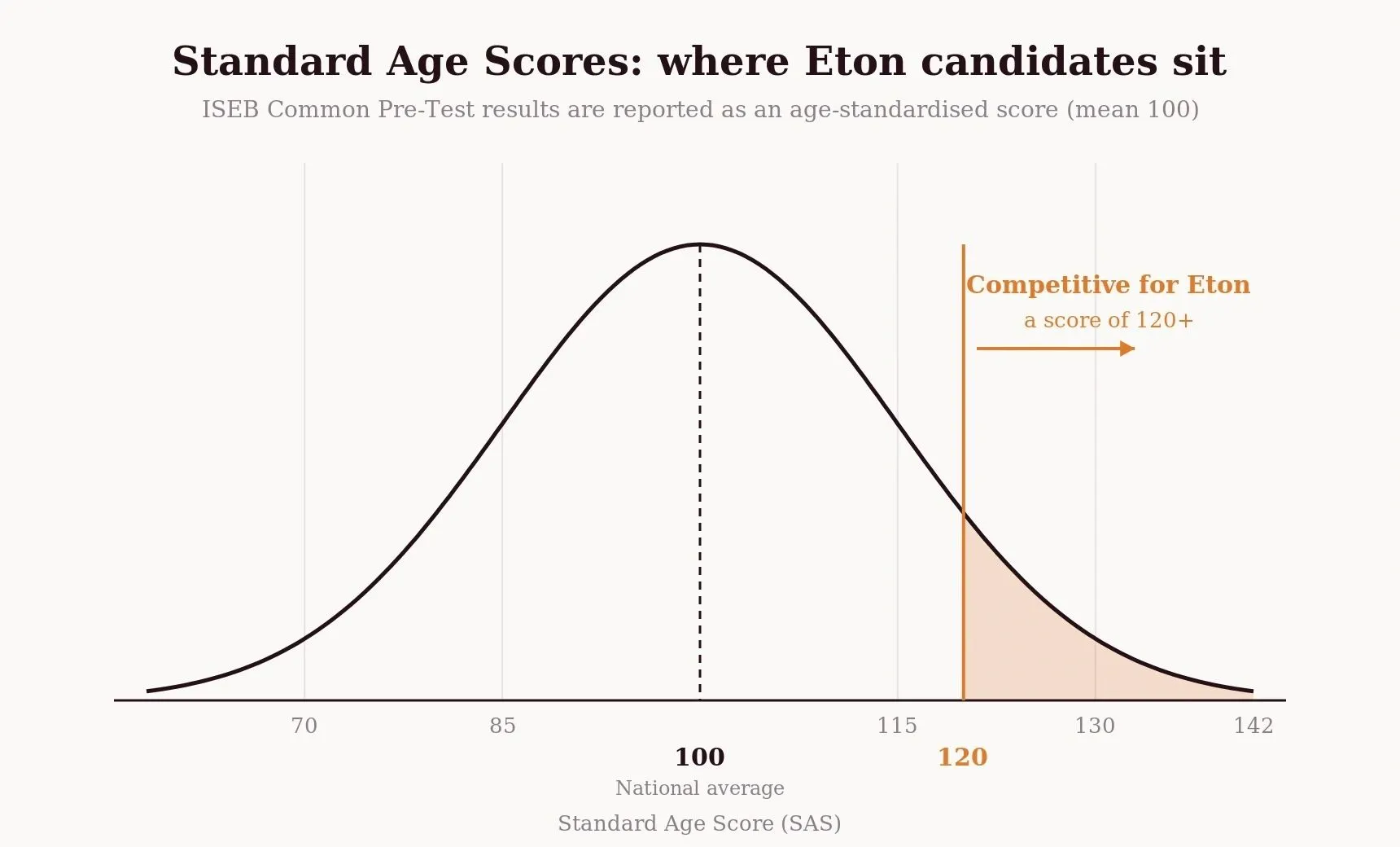
Optimal Eton ISEB scores
Because the results are standardised, they are easy to benchmark. A Standard Age Score of 100 is exactly average for a boy’s age — but Eton is among the most selective schools in the country, and the Pre-Test is only the first filter. In practice, most successful candidates are aiming for a score of around 120 or above, which places a boy comfortably within the top few per cent nationally, to be genuinely competitive as they progress through the assessment stages. A score at this level is not a guarantee, since Eton also weighs the Head Teacher’s report and the Stage 2 assessment, but it is the realistic target that keeps a boy firmly in contention.
Alongside the test data, Eton requests a Head Teacher’s report covering the boy’s academic strengths, interests and character. Eton then reviews both elements together and selects which boys progress to Stage 2, with Stage 1 outcomes communicated in December.
Because the Pre-Test can feel unfamiliar in format and because it is computerised, sensible preparation focuses on fluency and confidence across all four components rather than narrow drilling. Our companion pieces explain the exam in detail — see What is the ISEB? Understanding the Common Pre-Tests and How Eton College Uses CAT4 and Cognitive Data in Admissions for how standardised scores fit into the wider picture.
Stage 2: assessment at Eton
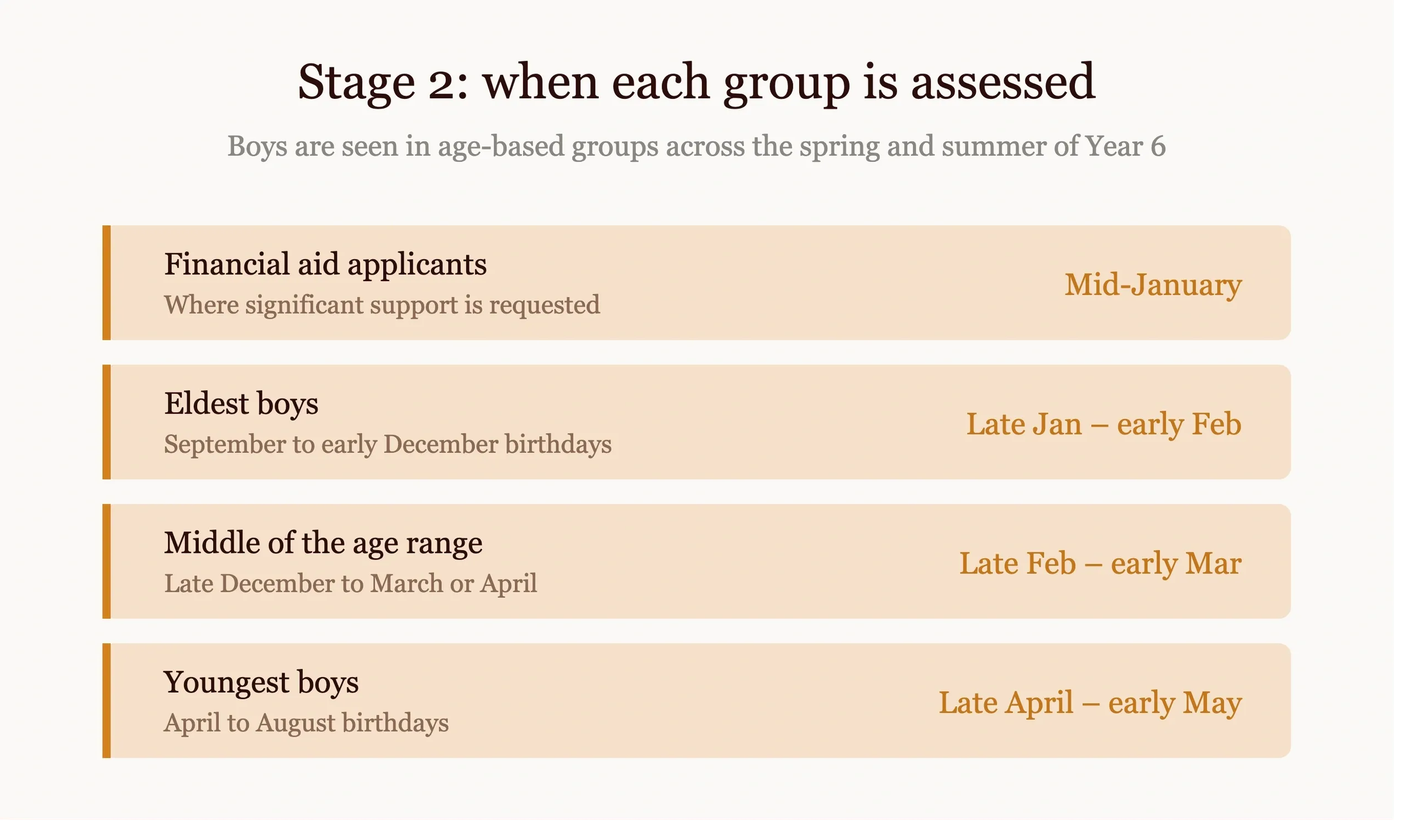
Boys who succeed at Stage 1 are invited to Eton in person during the spring and summer terms of Year 6. This does not happen on a single day. Instead, boys are assessed in age-based groups, which allows Eton to compare candidates at comparable points in their development:
Boys for whom significant financial aid is requested are assessed in mid-January; the eldest boys (broadly, birthdays from September to early December) in late January or early February; boys in the middle of the age range (later December through to March or April) in late February or early March; and the youngest boys (April to August birthdays) in late April or early May.
The Stage 2 assessment has two components: an individual interview, typically conducted by a House Master, and an online predictive test of academic ability and potential, taken on a computer and requiring, reportedly, minimal IT skills. Both matter, and neither result is treated in isolation.
The online test — often referred to as the Eton Test — is curriculum-independent. Eton provides no past papers and it cannot be revised for in the conventional sense; it probes reasoning, working memory and how a boy copes with unfamiliar problems under time pressure. The interview, meanwhile, is about fit and character rather than polish: House Masters vary in style, and over-rehearsed answers tend to stand out for the wrong reasons. For a deeper look, read Understanding the Eton List Test: Format, Content & Preparation, Decoding the Eton College Interview and our parent’s guide, Navigating Eton Stage 2 Assessments.
Eton publishes Stage 2 results in phases that mirror the assessment groups — in March, May and July respectively — taking the whole application into account.
How Eton reaches its decision
After Stage 2, Eton weighs everything together: Pre-Test performance, interview impressions, the Head Teacher’s report and overall suitability for boarding life. Outcomes fall into three categories.
A Conditional Place is the offer most families hope for. It is not yet a guaranteed place: it is confirmed later by satisfactory performance in further examinations at age 12/13 in Year 8 — the King’s Scholarship or Common Entrance. Families who accept a Conditional Place go on to meet a selection of House Masters during the first and second terms of Year 7 to find a suitable boarding house, and must pay the Acceptance Fee by the end of March in Year 7.
A Waiting List Place signals genuine interest without a present commitment. Boys offered a place on the waiting list may be invited back to Eton in the summer term of Year 7 for further assessment, and each year a number of waiting-list boys are admitted, though the figure varies. If your son is in this position, our articles What Does the Eton College Waiting List Mean? and the case study How to Get Into Eton College as a Late Applicant explain how families have converted a waiting-list place into a firm offer.
Finally, some boys are not offered a place at this stage. As we discuss in Not Offered a Place at Eton? What Parents Should Know, this is frequently a question of fit rather than raw ability, and many boys who fall short at Eton go on to thrive at other leading schools.
Stage 3: confirming the place via the Common Entrance or the King’s Scholarship
A Conditional Place holder confirms his entry in Year 8 by one of two traditional routes. Common Entrance is the standard 13+ examination sat by many prep-school boys. The King’s Scholarship is bespoke to Eton and is by far the more demanding path — for a conditional-place holder, a satisfactory performance in it guarantees entry even if he does not win a place in College.
Which route a boy takes is a strategic decision, usually made in consultation with his current Head Teacher, who is well placed to judge whether a scholarship attempt is realistic or whether Common Entrance is the wiser path.
Oppidans and King’s Scholars: understanding the difference
Eton draws a distinction that dates back to its founding. A small, academically elite group are King’s Scholars (denoted KS), who board together in College House under the Master-in-College and the Matron-in-College. There are 70 King’s Scholars at any one time, each with his own study-bedroom; aside from a few differences, a Scholar’s daily life closely resembles that of any other Etonian.
The prestige of the scholarship is considerable, but the practical point for families is this: winning a place in College is not the only reason to sit the King’s Scholarship. For a boy who already holds a Conditional Place, the examination can also serve as the means of confirming his entry.
All boys who are not King’s Scholars are considered to be Oppidans, who live in one of the school’s many boarding houses. It is possible, by dint of sustained excellence during a boy’s time at Eton, to be awarded an Oppidan Scholarship (OS). This scholarship is a mark of distinction but it is not accompanied by any financial assistance.
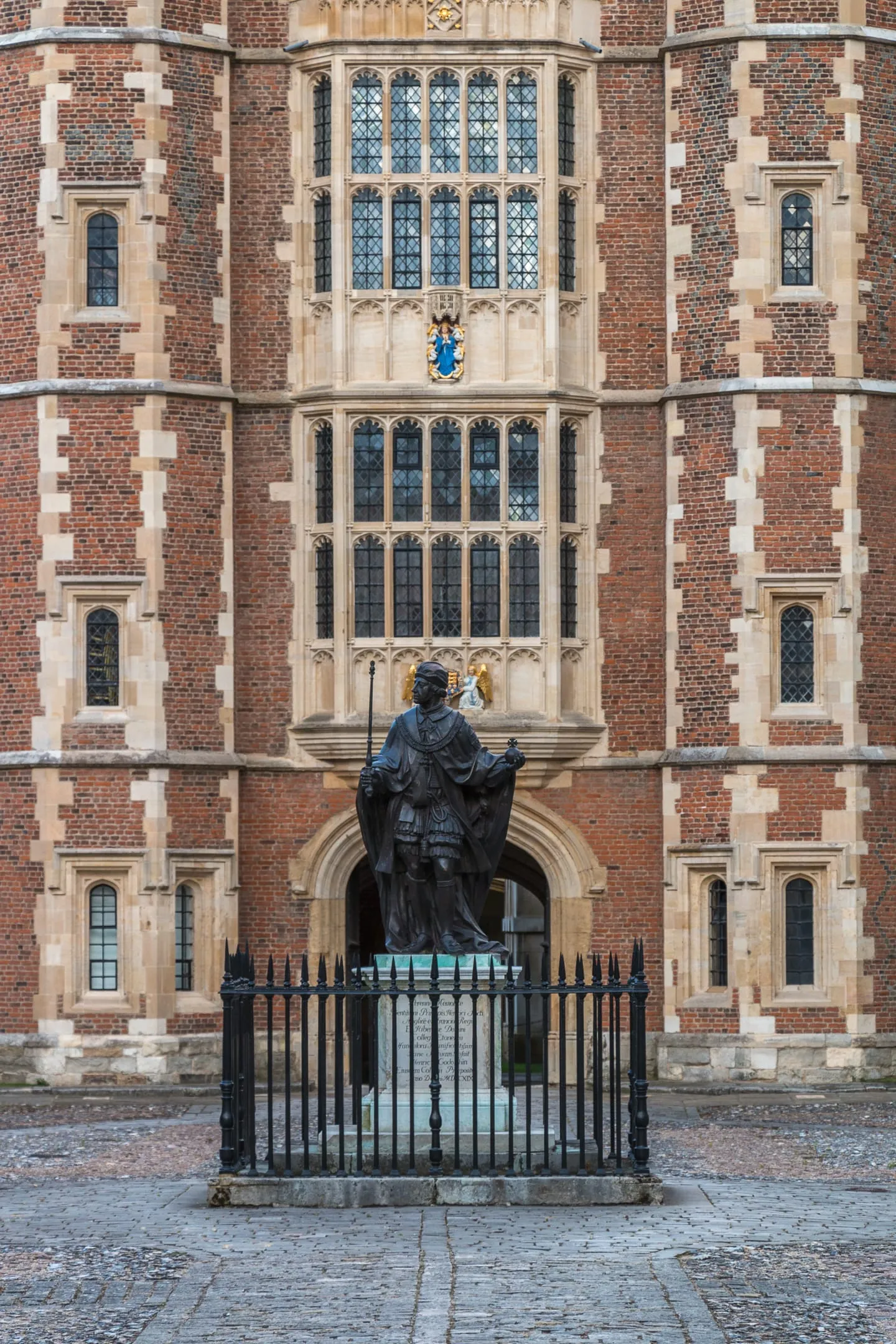
Martin Kraft, CC BY-SA 3.0
The King’s Scholarship in depth
Approximately 14 King’s Scholarships are awarded each year, usually tenable for five years. The examinations are held in late April and/or early May for entry the following September. Candidates must be 13 on 1 September of the year of entry, with a narrow provision for deferred August birthdays.
The exam is designed to identify the most able candidates and is intentionally very demanding. Every candidate sits several compulsory papers — currently English A, English B, Mathematics A, Science and General I — and at least three optional papers chosen from French, Latin, Greek, Mathematics B, General II and History-Geography-Divinity. A candidate is assessed on the compulsory papers plus his best three optional papers. The General papers are deliberately designed so that a boy who has had limited tuition in a given subject can still demonstrate raw intellectual potential.
Eton publishes recent King’s Scholarship past papers on its website, which are the single most useful resource for understanding the level and tone the examiners expect. Our case study Eton King’s Scholarship Preparation: Academic Excellence shows what focused, well-structured preparation looks like in practice.
Fees and financial aid
Eton is committed to significant financial support. In the 2023/24 academic year, 18% of boys received help towards their fees, with awards averaging 71% of the fee, and 99 boys paid no fees at all. Following the introduction of 20% VAT on school fees from January 2025, Eton’s spend on financial aid rose to well in excess of £10 million a year. Support cannot stretch to every applicant, but families should not assume the school is beyond reach: aid is means-tested and, at the top end, can cover fees in full. Requests for significant financial aid are also factored into the assessment timetable, with those candidates assessed earliest in the Stage 2 window.
A master timeline: from age 9 to 13+ entry
For families who like to see the whole board at once, the standard route runs as follows:
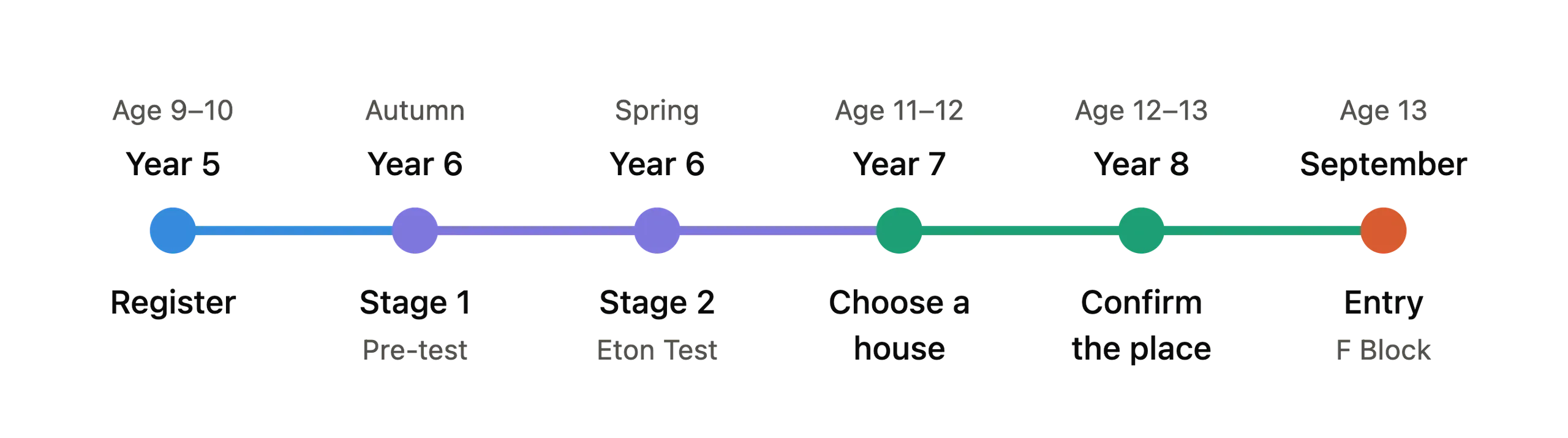
- Year 5 (age 9–10): Register your son before the 31 August deadline; pay the registration fee and submit the birth certificate. Book an admissions tour (Eton runs 13+ tours on Monday and Wednesday afternoons in term time).
- Year 6, autumn (age 10–11): Stage 1 — the ISEB Common Pre-Test in October or November, plus the Head Teacher’s report. Outcomes in December.
- Year 6, spring and summer: Stage 2 — the interview and online Eton Test at Eton, in age-based groups from January to May. Results in March, May or July.
- Year 7 (age 11–12): Conditional Place holders meet House Masters and select a boarding house; the Acceptance Fee is due by the end of March. Waiting-list boys may be reassessed in the summer term.
- Year 8 (age 12–13): Confirmation of the place through Common Entrance or the King’s Scholarship (the latter sat in late April/early May).
- September, age 13: Entry to Eton in Year 9 (‘F Block’). What Eton is really looking for
Parents often hunt for a single decisive factor — a score, a comment, a moment in the interview. In reality, Eton looks for consistency and potential. Strong candidates show academic promise across time rather than on one day, the cognitive flexibility to handle unfamiliar challenges and the honesty and self-knowledge to speak openly in conversation, together with a sense that Eton would suit them and they would suit Eton. There is no advantage in shortcuts or inflated claims; the process is deliberately built to reward steadiness over performance, and experienced House Masters are quick to spot a boy who has been over-coached.
A final word for parents
Most of the anxiety surrounding Eton comes not from the difficulty of any single stage but from uncertainty about where you are in the timeline and what you should reasonably be focusing on. A calm, well-judged approach — one that starts early, builds secure foundations and avoids over-coaching — is almost always the most effective.
Navigating the entire entry process requires a long-term strategy. If you would like to discuss whether Eton is a realistic option for your son and how best to approach it from where you are now, Pennyfeather Education offers calm, discreet guidance rooted in long experience of 11+ and 13+ admissions. Book a free 20-minute introductory consultation to talk it through.
Which other schools do Eton candidates apply to?
Very few families pin everything on a single school, and nor should they. Eton’s own two-stage process runs on a similar timeline to most leading senior schools, so boys preparing for Eton are typically preparing for two or three other 13+ options at the same time — often built around the same ISEB Common Pre-Test. Below are case studies from families who have navigated those parallel applications, grouped by school type.
All-boys schools
Boys aiming for Eton frequently also apply to other leading boys’ boarding schools, where the academic profile and boarding ethos are closest to Eton’s own. You may find the following articles helpful in considering your son’s options:
- Securing a Place at Radley College at 13+ with Expert Tuition
- Radley College 13+ Entry: Navigating the Pre-Assessment
- From the Radley List to an Unconditional Offer
- Securing a Harrow School 13+ Offer: The Three-Year Strategy
- Securing a Tonbridge 13+ Unconditional Offer: A Case Study
Co-educational schools
Others choose to keep a co-educational option open alongside Eton, at schools that combine strong academics with a broader social setting:
- How to Get a 13+ Offer from Wellington College
- Wellington College 13+ Entry: A Strategic Case Study
- Charterhouse 13+ Entry: Cracking the ISEB Pre-Test
- How Our Student Got a 13+ Offer from St Edward’s School, Oxford
- St Edward’s Oxford 13+ Admissions: The Pre-Test Route
- Stowe School 13+ Admissions: Long-Term Prep Strategy
- Navigating Oundle School 12+ Entry: A Success Story
Explore the Eton series
If you found this article to be helpful, you may wish to consider the other articles in our Eton series.
- What is the ISEB? Understanding the Common Pre-Tests
- Understanding the Eton List Test: Format, Content & Preparation
- Decoding the Eton College Interview: Topics, Details, Preparation
- Navigating Eton Stage 2 Assessments
- How Eton College Uses CAT4 and Cognitive Data in Admissions
- What Does the Eton College Waiting List Mean?
- Not Offered a Place at Eton? What Parents Should Know
- Mapping a Planned Route from ISEB Pre-Test to Eton List Test (case study)
- How to Get Into Eton College as a Late Applicant (case study) Source: As research for this guide, we consulted Eton College official admissions pages (etoncollege.com). These were accessed in July 2026. Figures such as fees, deadlines and award numbers are subject to change — always confirm against the current Eton website.
Pennyfeather Education is independent and not affiliated with, endorsed by or sponsored by Eton College or any other school.